Canadian Housing Activity Stays Quiet in February 2026
Monthly Housing Market Report
NATIONAL RESIDENTIAL STATISTICS


Ottawa, ON March 17, 2026 – The number of home sales recorded over Canadian MLS® Systems dipped 1.3% on a month-over-month basis in February 2026. (Chart A)
“February saw a continuation of the quieter levels of activity recorded in January, although there was some indication things were starting to pick up speed toward the end of the month,” said Shaun Cathcart, CREA’s Senior Economist. “2026 is still ultimately expected to be a story about pent-up first-time buyer demand finally seeing a chance to enter the market. They’ve had to wait a long time for mortgage rates to find a bottom, but some will no doubt continue to hold off for a bottom in prices in some Ontario and British Columbia markets.”
February Highlights:
National home sales edged down 1.3% month-over-month.
Actual (not seasonally adjusted) monthly activity came in 8.1% below February 2025.
The number of newly listed properties declined by 3.9% on a month-over-month basis.
The MLS® Home Price Index (HPI) fell 0.6% month-over-month and was down 4.8% on a year-over-year basis.
The actual (not seasonally adjusted) national average sale price was little changed (-0.2%) on a year-over-year basis in February 2026.
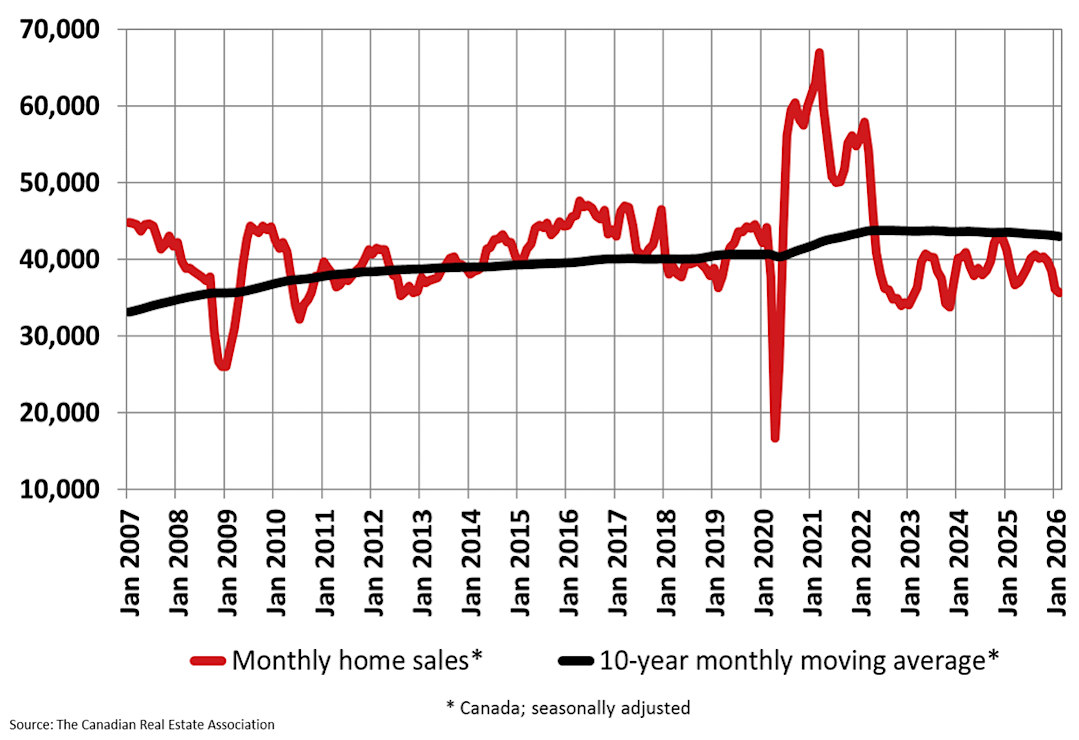
Chart A
New listings fell back by 3.9% on a month-over-month basis in February 2026, erasing the jump recorded in January.
With new supply down by more than sales in February, the national sales-to-new listings ratio tightened to 47.6% compared to 46.4% in January. The long-term average for the national sales-to-new listings ratio is 54.8%, with readings roughly between 45% and 65% generally consistent with balanced housing market conditions.
“Housing market activity in February remained slow, particularly in the stretch of Ontario between Windsor and Toronto,” said Valérie Paquin, CREA Chair. “That said, the main event never really gets going until around April, so there’s still time to get ready to buy or sell this year. Step one is getting in touch with a local REALTOR®.”
There were 151,850 properties listed for sale across all Canadian MLS® Systems at the end of February 2026, up 3.7% from a year earlier but 12.3% below the long-term average for that time of year.
There were five months of inventory on a national basis at the end of February 2026, unchanged from January and right in line with the long-term average for the measure. However, the national average masks wide regional differences, with no province currently at that level and only a handful of local markets close to it. Based on one standard deviation above and below that long-term average, a seller’s market would be below 3.6 months, and a buyer’s market would be above 6.4 months.
The National Composite MLS® Home Price Index (HPI) edged down 0.6% on a month-over-month basis in February, not a small decline but smaller than in January.
The non-seasonally adjusted National Composite MLS® HPI was down 4.8% compared to February 2025. (Chart B)

Chart B
Regionally, prices remain down on a year-over-year basis in B.C., Alberta, and Ontario, offsetting gains in other provinces.
The non-seasonally adjusted national average home price was $663,828 in February 2026, almost unchanged (-0.2%) from the same month last year.
The next CREA statistics package will be published on Thursday, April 16, 2026.


